I just got back from a bench trial in Chatsworth. For a year and a half, one side built their entire case on a stack of agreements. Then it came out that the signatures on those agreements had been cut and pasted from documents signed about three years earlier.
Once that came to light, they tried to quietly walk it back — after a year and a half and hundreds of thousands of dollars in attorney fees. But you can’t just drop fabricated documents and pretend it didn’t happen. Once you’ve submitted them to a court, your credibility on everything else goes out the window.
That’s what we call an electronic transfer: somebody takes your real signature from something you actually signed and pastes it onto a new document with completely different terms.
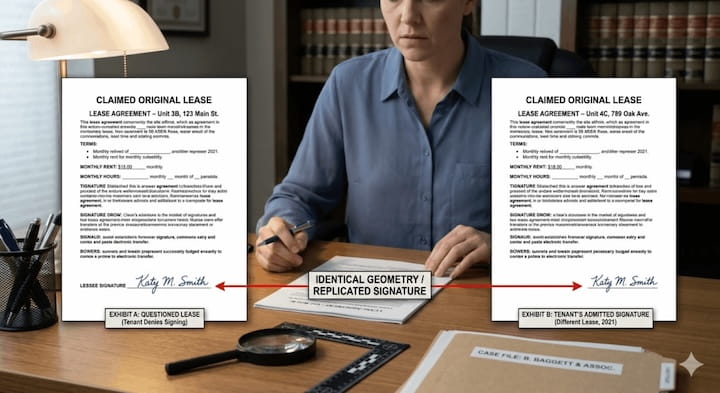
The same thing happens with leases, contracts, buyouts, stock agreements. If you’re being evicted or your rent is going up based on a lease you don’t remember signing, there are really two possibilities. Somebody forged your signature, or somebody grabbed your real signature from a lease you did sign and stuck it on a new one. The second one can be harder or easier to prove, depending on whether the original document turns up.
Either way, just saying “I didn’t sign that” usually isn’t enough. Judges and juries don’t take anybody’s word for it when both sides are pointing fingers — but they do listen to expert witnesses. So the evidence matters: the original lease, copies or photos of what you did sign, and 20 to 40 samples of your signature from around the same time period. Most tenants don’t save their leases, and that’s often where these cases get tough.
For the attorneys reading this: if your client is dealing with a disputed lease or a contract that looks like it was pieced together from earlier documents, the question for an examiner isn’t always whether the signature is real. Sometimes it’s how a real signature ended up on a document your client never agreed to. Those are different examinations, and the evidence you need to gather is different for each one.
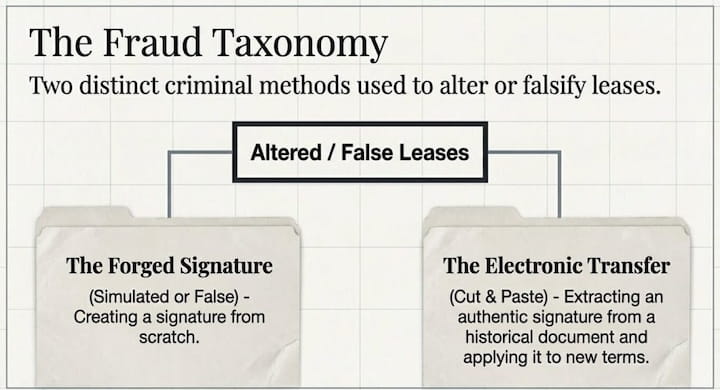
Sometimes the question isn’t “Is that my signature?” It’s “How did my signature get onto this document?”
Frequently Asked Questions
What should I do if my landlord is trying to evict me based on a lease I never signed?
Gather all available evidence, especially any copy of the original lease you did sign. Then hire a forensic handwriting expert to analyze the disputed document. A qualified expert can determine whether your signature was forged or digitally transferred from a previous agreement.
How can a forensic handwriting expert prove a lease signature was forged?
A forensic handwriting expert collects 20 to 40 authentic signature samples from the relevant time period and scientifically compares them to the disputed signature. They can then testify in court with an evidence-based opinion that the signature is a forgery or an electronic cut-and-paste transfer.
What is electronic cut-and-paste forgery on a lease?
Electronic cut-and-paste forgery — also called an electronic transfer — occurs when a fraudulent party takes a genuine signature from a previously signed document and digitally transplants it onto a new lease with altered or fabricated terms. This is a form of document fraud and is a criminal act.
Why do tenants often struggle to prove a lease is fraudulent?
Most tenants do not retain copies of their original leases or photograph documents they sign. Without the original agreement, proving a landlord’s document is fraudulent becomes significantly more difficult, making professional expert analysis and thorough evidence gathering essential to a successful case.
— Bart Baggett
Forensic Document Examiner · Expert Witness
https://HandwritingExpertUSA.com
· 1-800-980-9030
Los Angeles, Orange County, Phoenix, Dallas, Miami